 English
 Español
 Português
 русский
 français
 日本語
日本語 Deutsch
 Tiếng Việt
 Nederlands
 ไทย
ไทย Polski
 한국어
한국어 Svenska
 magyar
 Malay
Malay বাংলা
বাংলা Dansk
Dansk Suomi
Suomi हिन्दी
 Pilipino
 Türk
Türk Gaeilge
 عربى
عربى Indonesia
 norsk
norsk čeština
 Ελληνικά
 Українська
 नेपाली
 Burmese
 български
 ລາວ
ລາວ Latine
 slovenský
 Lietuvos
Which kinds of drawing dies are divided into, where to use?
Which kinds of drawing dies are divided into
where to use?
Which kinds of drawing dies are divided into, where to use?
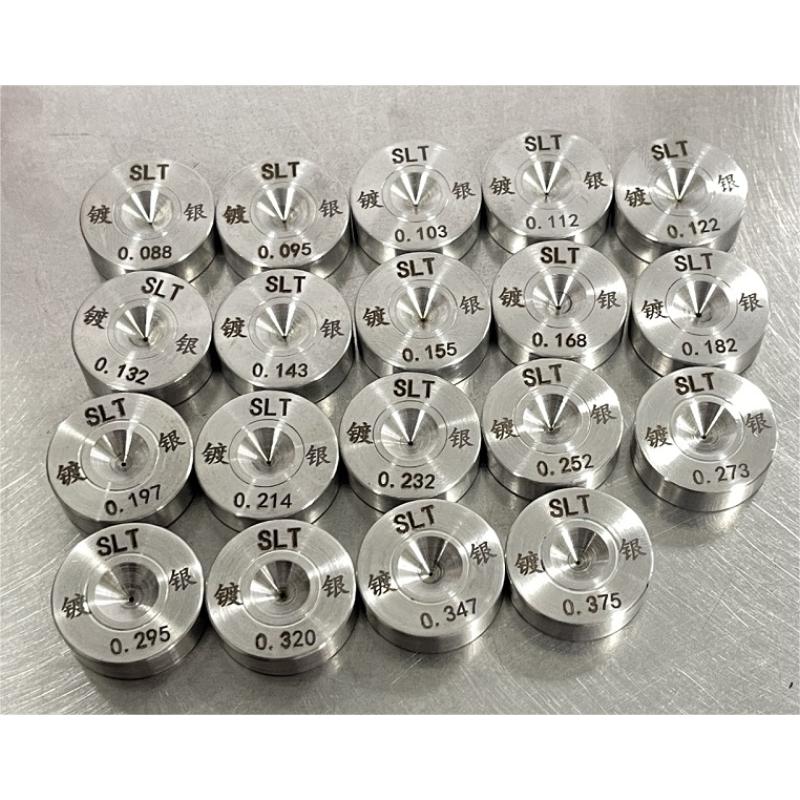
Wire drawing die is widely used in electronic devices, radar, television, instruments, aerospace and other industries of high-precision wire, as well as applied in tungsten wire, molybdenum wire, stainless steel wire and other industries of wire drawing die. Secondly, wire and cable wires and various alloy wires are made of diamond wire drawing die.
The working principle of the wire drawing die is to thin the wire from the coarse, and gradually reach the desired size of the die. This special mold is a wire drawing die. Drawing dies are usually made of natural diamond and synthetic diamond (synthetic diamond including ge, pcd, synthetic materials, etc.). Copper wire drawing die belongs to soft wire drawing die. There are also hard wire drawing molds, such as tungsten wire drawing. The compression zone Angle of the copper wire drawing die is generally 16-18 degrees, and the length of the ruler is 30-40%, while the compression zone Angle of the tungsten wire drawing die is relatively small, generally 12-14 degrees, and the length of the ruler is 60-70%.

Changzhou Shen Litong Mould invites you to visit the exhibition
From August 27th to 29th, 2025, at SHANGHAI NEW INTERNATIONAL EXPO CENTRE,the 12th China International Wire&Cable Industry Exhibition (Hall E1, G21), Shen Litong Dies sincerely invites you to visit, exchange and offer guidance, and jointly explore new developments in the industry.
Read MoreChangzhou Shen Litong Mould CO.,LTD. will participate in the 12th All China - International Wire & Cable Industry Trade Fair
Changzhou Shen Litong Mould CO.,LTD. will participate in the 12th All China - International Wire & Cable Industry Trade Fair
Read MoreTackling Tough Drawing Challenges: Die Solutions for Exotic Alloys, Shaped Wires & Micro-Wires
In the development of finer, stronger and more complex wire products, manufacturers constantly break through the limits of material science and precision engineering. Drawing high-strength exotic alloys, producing complex shaped profiles, and manufacturing micro-wires below 0.1 mm bring unique tribological and mechanical challenges.
Read More