 English
 Español
 Português
 русский
 français
 日本語
日本語 Deutsch
 Tiếng Việt
 Nederlands
 ไทย
ไทย Polski
 한국어
한국어 Svenska
 magyar
 Malay
Malay বাংলা
বাংলা Dansk
Dansk Suomi
Suomi हिन्दी
 Pilipino
 Türk
Türk Gaeilge
 عربى
عربى Indonesia
 norsk
norsk čeština
 Ελληνικά
 Українська
 नेपाली
 Burmese
 български
 ລາວ
ລາວ Latine
 slovenský
 Lietuvos
Tackling Tough Drawing Challenges: Die Solutions for Exotic Alloys, Shaped Wires & Micro-Wires
Tackling Tough Drawing Challenges: Die Solutions for Exotic Alloys
Shaped Wires & Micro-Wires
Introduction
In the development of finer, stronger and more complex wire products, manufacturers constantly break through the limits of material science and precision engineering. Drawing high-strength exotic alloys, producing complex shaped profiles, and manufacturing micro-wires below 0.1 mm bring unique tribological and mechanical challenges. As the core forming component, drawing die determines the success of the process: failures such as wire breakage, dimensional instability and poor surface quality directly reduce yield and profitability. Solving these challenges requires upgrades in die material selection, internal geometry design and surface finishing technology. This paper introduces specialized die solutions for processing these three types of high-demand wire products.
1. Conquering Exotic Alloy Wire Drawing
Titanium alloys and high-temperature superalloys have extremely high tensile strength and rapid strain hardening, bringing huge stress to the die deformation zone, and are prone to adhesive wear/galling that degrades surface quality and causes catastrophic wire breakage. To address this, superior die materials are required: standard tungsten carbide for ordinary carbon steel cannot withstand the harsh condition, while ultra-fine grain hard carbides, or Polycrystalline Diamond (PCD) dies for the most severe applications, provide excellent hardness and adhesive wear resistance, eliminating material pick-up on the die surface. Besides material selection, optimized die geometry can evenly distribute deformation and reduce local stress peaks. Advanced low-friction inert coatings reduce friction and heat generation, preventing adhesive bonding that causes surface defects. Matching cooling system and high-stability lubricant are also critical supporting conditions for optimized die design.
2. Mastering Shaped and Profile Wire Dies
Drawing non-round profile wires brings great challenges in uniform deformation and contour control: material flow is highly uneven across the cross-section, leading to stress fracture or incomplete die filling, and extremely high precision is required for complex cavity manufacturing. The core solution is controlling material flow via carefully designed transition zones that gradually guide metal from round feedstock to the final profile, ensuring simultaneous filling of all cross-section areas. CAD and simulation software are used to model material flow and predict stress concentration before production. High-precision manufacturing techniques including Wire EDM, laser machining and specialized diamond polishing are applied to get the required high-quality surface, and specialized fixtures guarantee correct alignment during drawing.
3. The Extreme Demands of Micro-Wire Drawing
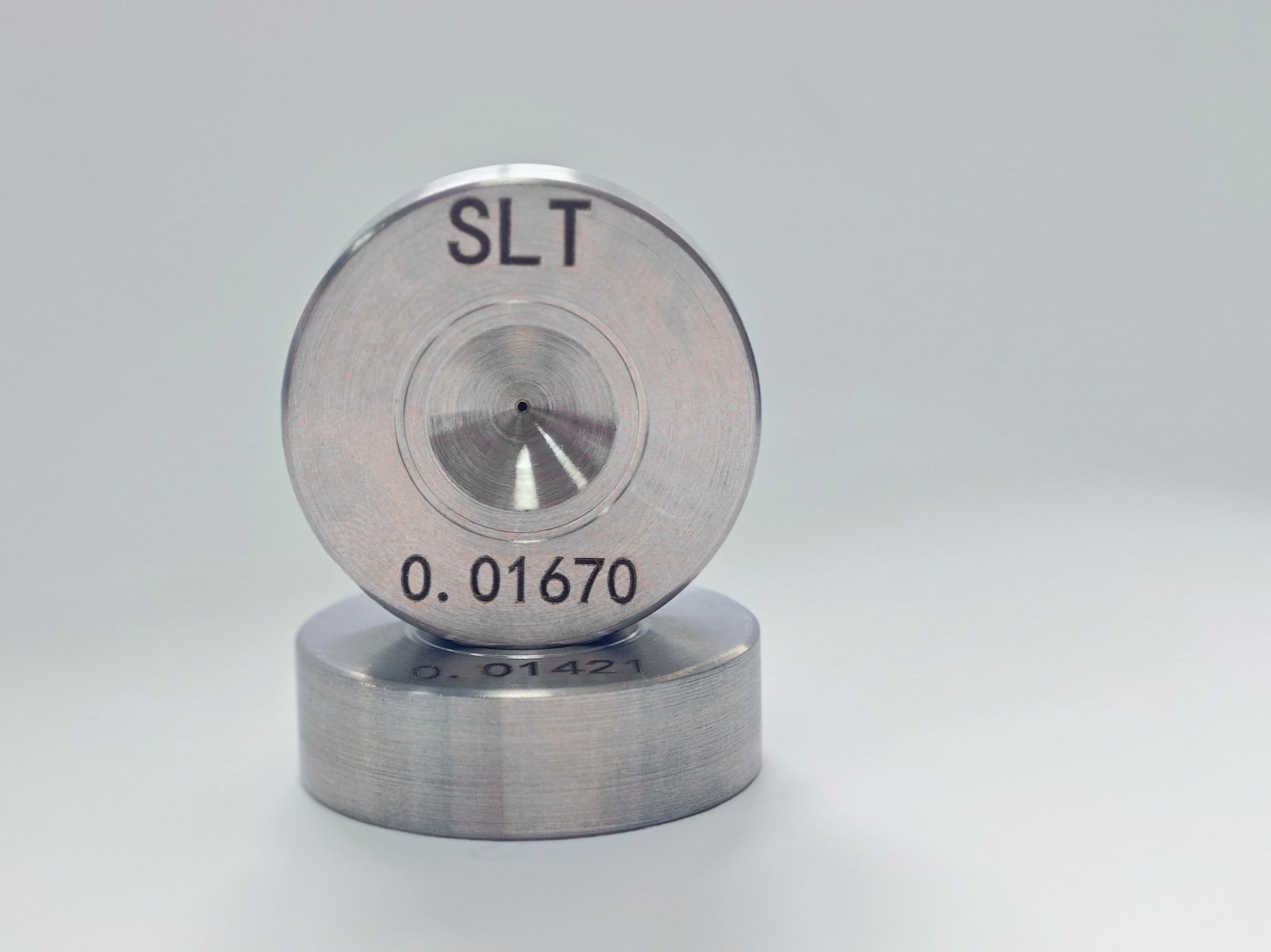
Micro-wire drawing (diameter below 0.1 mm, even down to 0.01 mm) requires nanometer-level tolerance, so structural uniformity of die material is more important than basic mechanical properties. Single Crystal Diamond (SCD) or nano-grained PCD are required for their excellent isotropy, which can achieve angstrom-level ultra-smooth low-friction surface finish. The internal geometry of micro-wire drawing dies requires extreme precision, with multi-zone architecture and precisely controlled angles and shortening bearing length. It also requires extremely strict process control including incoming wire surface preparation, ultra-clean lubricant and vibration-dampened equipment. Customized micro-wire dies can significantly reduce drawing force and wear, enabling stable mass production of 0.01 mm grade micro-wires for electronics, medical devices and aerospace instrumentation.
Conclusion
Mastering the drawing of exotic alloys, shaped wires and micro-wires requires deep expertise integrating material science, precision manufacturing and tribology into die development. Advanced die materials, computational geometry optimization and extreme finishing technology enable manufacturers to overcome these technical limitations. We welcome partnership to solve your most difficult wire drawing challenges.

Changzhou Shen Litong Mould invites you to visit the exhibition
From August 27th to 29th, 2025, at SHANGHAI NEW INTERNATIONAL EXPO CENTRE,the 12th China International Wire&Cable Industry Exhibition (Hall E1, G21), Shen Litong Dies sincerely invites you to visit, exchange and offer guidance, and jointly explore new developments in the industry.
Read MoreHow Nano Coated Diamond Wire Drawing Dies Improve Wire Drawing Performance
Wire drawing is a precision metal forming process in which wire is pulled through a die to reduce its diameter and improve dimensional accuracy.
Read MoreOn-Site Technical Support: Tackling Multi-Wire Die Breakage together with the Customer
Recently, our technical service team went to the customer's production floor to work shoulder to shoulder with their engineers, launching a targeted campaign against frequent breakage in multi-wire drawing dies.
Read More